When the Boardroom Conversation Keeps Going in Circles

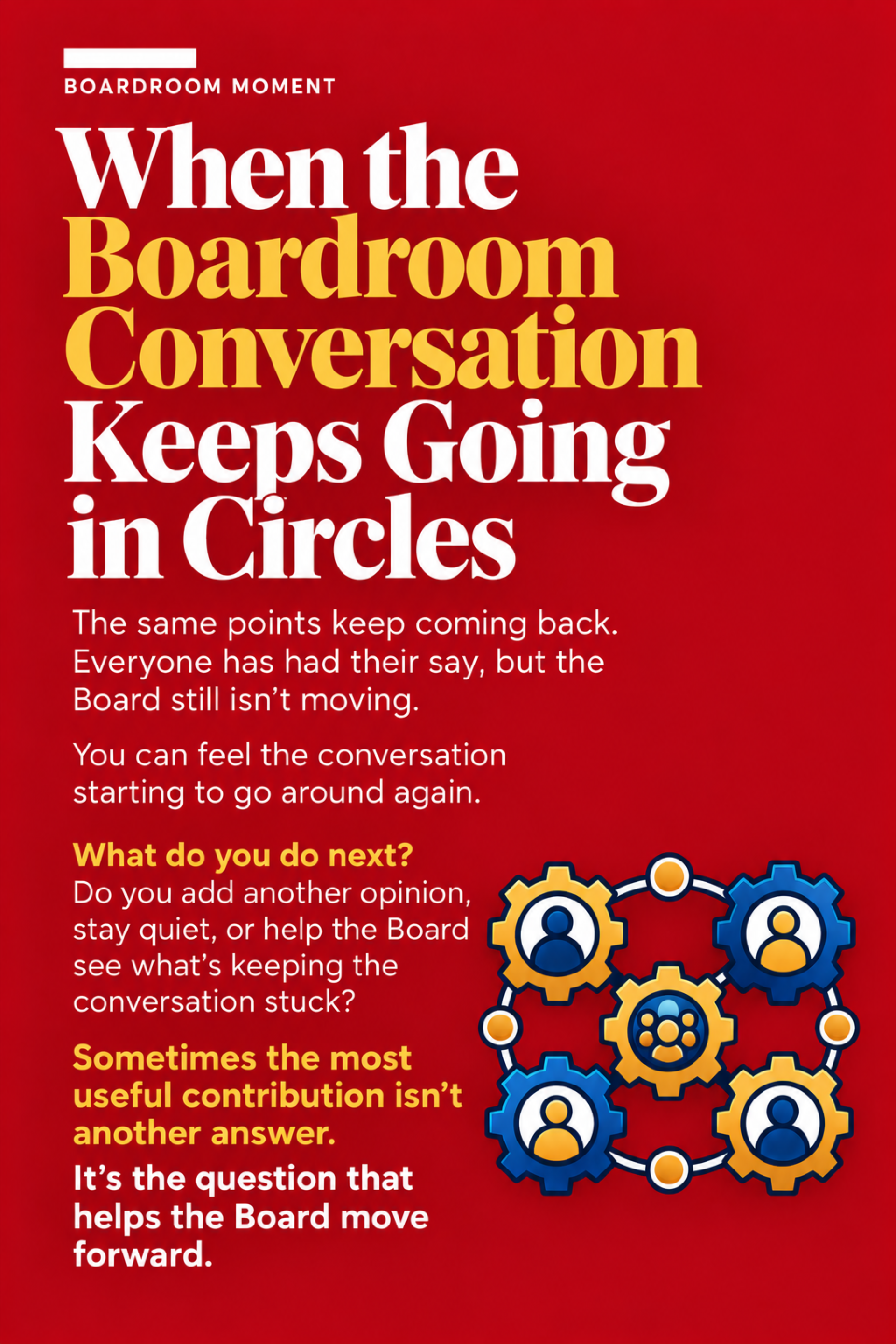
In this Boardroom Moment:
We’re looking at: What do you do when the Boardroom conversation keeps going in circles?
Have you ever been in a Board meeting where you suddenly think, we’re going around in circles here?
Everyone’s talking. The same points keep coming up. But you’re no closer to a decision.
And now there’s a tension in the room.
Do you say something or stay out of it?
Do you add your view or risk making the conversation even longer?
Sometimes the Board doesn’t need another opinion.
It needs to work out what’s keeping the conversation stuck.
So, what can you do to get things moving again?
Let’s put this into a real boardroom situation.
You’ve been discussing the same issue for twenty minutes.
Everyone’s had their say. You’ve talked through the risks and gone back over the papers. But the conversation keeps coming back to the same place.
One director raises a concern you’ve already discussed. Another comes back to the solution they suggested earlier.
The Board is talking, but it’s not moving.
You can feel the frustration starting to build.
Someone looks to the Chair, hoping they’ll find a way to move things on.
What do you do when you can see that the Board is stuck?
The temptation is to step in and solve it; to summarise the discussion, suggest a compromise, push for a decision or explain your own position again.
If everyone has already had their say, another opinion may not help.
Instead, listen for what’s still unresolved.
- Is the decision itself unclear?
- Are people working from different assumptions? Is something missing
- Are directors seeing the risk differently?
- Or is there a concern no one has quite said out loud?
Once you can see what’s holding things up, name it.
You might say: “I think we may be working from different assumptions here.”
Then ask: “Is that what’s stopping us from moving forward?”
From there, work out what the Board needs next.
- More information?
- An assumption checked?
- A clearer view of the risk?
- Or is it simply time to make the decision?
You’re not taking over the conversation.
You’re helping the Board see what’s stuck and what needs to happen next.
What can you do when you realise the conversation is going nowhere?
Start by helping everyone see what’s happening. Make the conversation visible.
Rather than adding another opinion, help the Board work out what’s keeping it stuck.
You might say: “We keep coming back to the same points. What haven’t we resolved?”
Or: “Are we disagreeing about the decision—or the assumptions behind it?”
Or: “What do we need to know or agree on to move forward?”
That shifts the conversation away from individual positions and back to what the Board actually needs to resolve.
The key is not to use the question to push your own view.
You’re not trying to win the argument. You’re helping the Board move its thinking forward.
When the conversation gets stuck, how do you help move things forward without taking over?
You don’t need to take over the Chair’s role. And you probably don’t need to add another opinion.
Instead, listen for what’s really holding things up.
Maybe the assumptions are different. Maybe people see the risk differently. Or perhaps the Board has simply lost focus on the decision in front of it.
Is the real disagreement about the assumptions? The risk? Or what the Board is actually being asked to decide?
You might say: “I wonder if we’re trying to answer two different questions here.”
Or simply: “What decision do we actually need to make?”
Then let the Board take it from there.
You’re not trying to steer the conversation towards your answer.
You’re helping the Board get clear about what it needs to resolve.
Sometimes a Board discussion goes in circles because everyone is defending a position without being clear about what they actually disagree about.
What looks like disagreement may actually be something else. Directors may be working from different assumptions, focusing on different priorities, or seeing the risks differently.
What sounds like disagreement may simply be directors approaching the same decision from different perspectives.
So rather than adding another opinion, try to find out where the disagreement really sits.
Three Questions that can reset the conversation
When the conversation starts going in circles, try bringing it back with three simple questions.
First: “What are we actually being asked to decide?” Board discussions can easily drift. This brings everyone back to the decision in front of them.
Then: “What are we really disagreeing about?” It may not be the decision itself. Perhaps you’re working from different assumptions, seeing the risks differently, or putting more weight on different priorities.
And finally: “What should determine our decision?” Is it strategy? Risk? Financial impact? Organisational capability? Stakeholders? Timing? Once that’s clear, the conversation can move away from individual positions and back to what really matters.
You’re no longer repeating positions. You’re getting clear about what the Board actually needs to resolve.
So when the conversation starts going in circles, come back to three questions: What are we deciding? Where do we disagree? What should guide our judgement?
You’re not telling the Board what to decide. You’re helping everyone get clear about what needs to be resolved.
If more information is requested, ask: “Do we genuinely need this to decide or would it simply make us more comfortable?”
And if directors are defending different options, shift the conversation to consequences, ask: “If we choose this option, what happens next?”
Sometimes the Board has enough information but is looking for reassurance before making a difficult decision. At some point, directors have to exercise judgement.
And if the Board genuinely isn’t ready to decide, stop going around the issue. Agree on what information is needed, who will provide it and what happens next.
A useful circuit-breaker is: “Can I pause us for a moment? What are we deciding, what are we actually disagreeing about, and what do we still need before we can decide?”
You’re not trying to win the argument or take over the meeting.
You’re helping the Board get clear enough to make a sound decision.
Here’s a simple sequence you can use.
First, pay attention to what the conversation is telling you. Before you jump in, work out what's actually happening. Are people repeating themselves? Are they talking about different things? Is everyone clear about what needs to be decided?
Then name what you're noticing. You don't need to make a big intervention. Sometimes it's enough to say: “We seem to be coming back to the same points.”
Then work out what’s still unresolved. Ask: “What haven’t we resolved yet?”
Maybe you’re starting from different assumptions. Maybe there’s something you still don’t know. Or maybe you just see the risk differently.
Then work out what you need to move forward.
Ask: “What do we still need to know or agree on?”
Maybe you need more information. Or maybe you already know enough and it’s time to decide.
Then hand it back.
If you’re not the Chair, you don’t need to take over.
You might simply say: “Chair, would it help to clarify that before we move on?”
Then let the Chair take it from there.
So, next time the conversation starts going in circles, don’t add another opinion.
Ask: “What haven’t we resolved yet?”
Because sometimes the Board doesn’t need more discussion.
It needs clarity about what’s keeping it stuck.
LEADERSHIP SERVICES
Become the leader you were always meant to be
Lorem ipsum dolor sit amet, metus at rhoncus dapibus, habitasse vitae cubilia odio sed. Mauris pellentesque eget lorem malesuada wisi nec, nullam mus. Mauris vel mauris. Orci fusce ipsum faucibus scelerisque.
SCHEDULE FREE CONSULTATION