How to Say “I Don’t Know” Like a Responsible Director

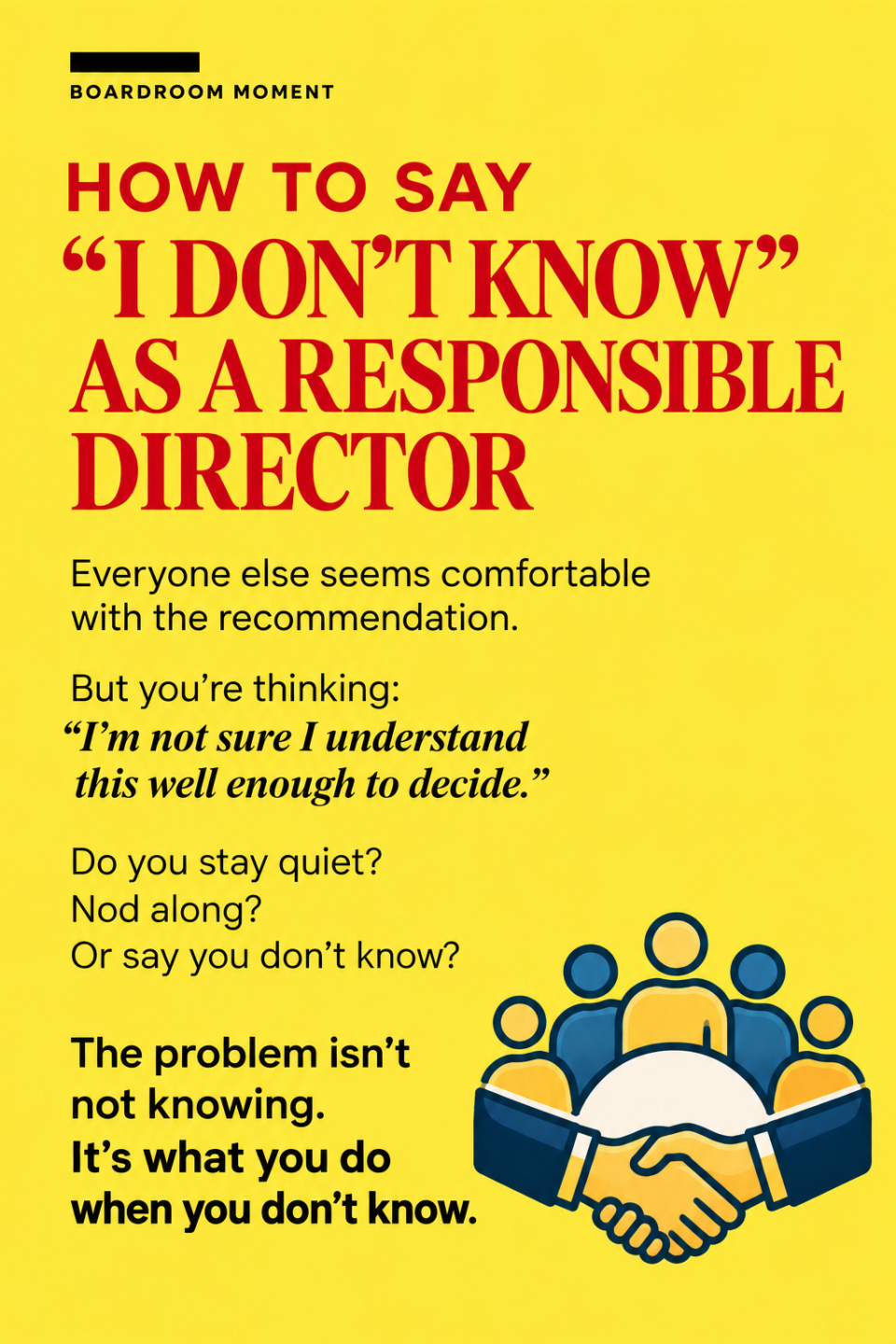
In this Boardroom Moment:
We’re looking at something every director faces: What do you do when you don’t know? You won’t always have the answer. What matters is how you respond—and what you do next.
As a director, you’re not expected to know everything. That’s why Boards bring together people with different experience, expertise and perspectives.
There will be times when you don’t have the answer. You may not understand a new technology. You may question the assumptions behind management’s forecast. Or you may be considering an acquisition and feel you don’t fully understand the risks.
You may simply be thinking: “I’m not quite sure what we’re being asked to decide.”
That’s fine. The important thing is what you do next.
Do you stay quiet and hope someone else asks the question?
Do you nod along because everyone else seems to understand?
Or do you say: “I don’t know.”
Sometimes that’s exactly the right thing to say. It may uncover something the Board has missed or show that more information is needed.
But don’t leave it there.
Ask: “What do I need to understand before I can make this decision?”
You’re being honest about what you don’t know, while staying engaged with the decision.
The problem isn’t not knowing. It’s what you do when you don’t know.
A responsible director doesn’t need to have all the answers. But you do need to stay engaged. You’re not expected to know everything about finance, technology, regulation, people, markets and risk.
You need to understand enough to make an informed decision.
And sometimes that starts by saying: “I need to understand this better.”
Then ask yourself: What don’t I understand? Does it matter to the decision? What do I need to know before I can form a view?
Sometimes you just need to ask a question. Sometimes management needs to explain something differently. And sometimes you need more information or independent advice.
You don’t need to understand every technical detail or become the expert in the room.
But you do need to ask yourself: “Do I understand enough to make this decision?”
Listen to management. Seek advice. Learn from the experts. But don’t hand the decision over to them. You don’t need to know everything. You need to understand enough to make up your own mind.
So, when you don’t know, be honest about it. Don’t pretend you do.
It’s easy to feel you should know the answer, especially when everyone else seems confident.
But sounding confident isn’t the same as understanding the issue.
When you don’t know, don’t stop at “I don’t know.”
Turn it into a question: “What do I need to understand before I can form a view?”
If you’re unsure about a forecast, ask: “What assumptions are driving it?”
If it’s a technology you don’t understand: “What are the main risks?”
If you’re not convinced by an assumption: “What evidence supports it?”
You don’t need to know everything. You need to work out what you need to know before you decide.
A Boardroom example
Imagine management is asking the Board to approve a major investment in a new technology platform. You’re not a technology expert. The presentation is technical, and everyone else seems comfortable with it.
It would be easy to stay quiet. Instead, you might say: “I don’t understand all the technology, but I do need to understand the risk. What could go wrong, and what would that mean for the organisation?”
You’re not trying to become the technology expert.
You’re asking what you need to understand as a director.
And that question might uncover something the Board hasn’t considered—a supplier dependency, an unrealistic timetable, additional costs or a risk that hasn’t been fully explored.
So don’t let “I don’t know” end the conversation. Use it to find the question that needs to be asked.
If something isn’t clear, ask: “I don’t understand that assumption yet. Can you take me through it?”
Don’t feel you have to prove how much you know. If you’re not sure, say so. You might say: “I don’t know enough about this yet to have a firm view.” Or: “I need to understand that assumption better.”
Or simply: “What happens if we’re wrong?” Asking the question doesn’t weaken your contribution. It may uncover something the Board has missed.
You don’t have to know everything. No director does.
Know what matters
What matters is knowing what you need to understand before you make the decision. The job isn’t to know everything. It’s to know what matters.
But being a director means you can’t simply leave the difficult parts to management, another director or an adviser.
You still have to understand enough to take responsibility for the decision you’re being asked to make.
So when you find yourself thinking, “I don’t know enough about this,” get specific.
Ask yourself: What is the Board actually being asked to decide?
What do I need to understand before I can make that decision?
What am I still unclear about?
What assumptions are we relying on?
What could materially change the decision?
And perhaps most importantly: “Is there anything I still need to understand before I can responsibly support this decision?”
That doesn’t mean removing every uncertainty. Boards often have to make decisions without having all the information they would like.
The question is whether you have enough of the right information to fulfil your responsibility as a director.
If you don’t, say so.
Ask management to explain the assumption. Request the information that matters. Seek independent advice if the issue warrants it. And if something material remains unclear, don’t support the decision simply because everyone else appears comfortable.
You can listen to management. You can rely on expertise. You can take advice.
But ultimately, you still have to make up your own mind.
That’s the distinction.
You don’t need to know everything. You need to know enough to take responsibility for the decision you make.
Raise it with the right person
So, you’ve decided the concern needs to be raised again. The question now is, who do you talk to?
In most cases, start with the Chair, and don’t leave it too long.
Be clear about what’s still concerning you and why you think it matters.
If there’s new information, say what it is. And be clear about what you’re asking for.
Do you want the Chair to reconsider the issue? Bring it back to the Board? Or simply talk it through with you?
The clearer you are about what you’re asking for, the easier it is for the Chair to respond.
You might say: “I respect the Board’s decision, but I’m still concerned that we didn’t fully consider whether the organisation can implement it. I’d like to explain why I think we may need to look at this again.”
You’re not accusing the Board of making the wrong decision. You’re making sure the decision has been properly considered.
Don’t campaign outside the boardroom
There’s one more thing to watch. You might find yourself wanting to call another director and ask what they thought.
That’s understandable. But before you do, ask yourself: Am I trying to understand what happened—or am I trying to get someone on my side?
Talking it through is one thing. Trying to build support for your position is another.
If you still have concerns, you may be tempted to contact other directors and ask whether they agree.
But this can create factions and lead to decisions being shaped outside the boardroom.
Ask yourself: “Am I trying to understand the issue—or persuade others to support my position?”
If the matter needs more discussion, bring it back through the proper Board process so everyone can consider it.
Be clear about what you’re asking for
And remember, raising a concern doesn’t necessarily mean asking the Board to change its decision.
You might simply need a clearer answer from management. Perhaps there’s information you haven’t seen, an assumption that needs checking, or you think the Board needs independent advice.
Sometimes the issue just needs another conversation before anything happens. In other cases, you may want it brought back to the Board—or have your concern formally recorded.
The important thing is to make sure what you’re asking for matches the seriousness of the concern.
If it’s a relatively minor issue, clarification may be enough.
But if it involves something more serious—legality, solvency, safety, ethics, or your responsibilities as a director—it may need to be dealt with quickly, and you may need professional advice.
Let’s put this into a real boardroom situation.
Imagine the Board has just approved a major technology investment.
During the meeting, you asked whether the organisation really had the capacity to implement it. Management gave an assurance, and the conversation moved on.
But after the meeting, you keep thinking about it.
You realise it’s not the technology itself that concerns you. It’s whether the organisation can introduce it without disrupting essential operations.
So rather than calling other directors to see what they think, you speak to the Chair.
You might say: “I’ve been thinking about the decision we made today. I’m not trying to hold it up, but I’m still concerned about whether we have the capacity to implement it properly. Could we get some clearer assurance before we make the final commitment?”
That’s a very different conversation from simply saying, “I still think we made the wrong decision.”
You’ve explained what concerns you, why it matters, and what you’d like to happen next.
That’s the kind of conversation that helps a director raise a concern without turning it into a campaign against the Board’s decision.
So, you’ve raised your concern and the Board still decides to proceed.
What now?
Ask yourself: Was my concern heard?
- Did the Board have the information it needed?
- Was the right process followed?
If so, it may be time to accept the decision, even if you still disagree.
Your responsibility is to make sure the concern is heard, not to make sure you win the argument.
Responsible challenge doesn’t mean continuing until others agree with you. It means making sure important concerns are properly considered.
If the issue is serious or relates to your legal duties, seek governance or legal advice rather than relying on informal reassurance.
So, think about your own experience for a moment.
Have you ever left a Board meeting with something still bothering you?
What did you do? Did you raise it again, or decide to let it go?
And if you let it go, why?
Maybe you didn’t want to appear difficult. Or perhaps you weren’t quite sure how to put your concern into words.
And here’s another question: Did I want the Board to reconsider the issue or did I simply want them to agree with me?
If you found yourself in that situation again, what might you do differently?
Try this after your next meeting
After your next Board meeting, take a couple of minutes and ask yourself:
Is there anything I’m still uncomfortable with?
What hasn’t been resolved?
Do I simply disagree—or has something important been missed?
And if I need to raise it: Who do I need to speak to, and what am I asking for?
You don’t need to revisit every decision.
Just notice what still needs your attention and decide what to do next.
So, here’s the thought I’d leave you with.
If something still concerns you after the meeting, don’t ignore it just because everyone else has moved on.
Ask yourself: Do I simply disagree—or has something important been missed?
If it matters, raise it. Explain what concerns you, why it matters, and what you think needs to happen next.
But speaking up doesn’t mean continuing until everyone agrees with you.
If your concern has been heard and considered, it may be time to accept the decision and move on.
So when you leave your next Board meeting with something still bothering you, ask yourself: Does the Board need to hear this again or do I need to let it go?
LEADERSHIP SERVICES
Become the leader you were always meant to be
Lorem ipsum dolor sit amet, metus at rhoncus dapibus, habitasse vitae cubilia odio sed. Mauris pellentesque eget lorem malesuada wisi nec, nullam mus. Mauris vel mauris. Orci fusce ipsum faucibus scelerisque.
SCHEDULE FREE CONSULTATION